
We are officially through the first half of 2026, and the industry barely stopped to catch its breath. Drugmakers are spending like the window is closing, obesity has minted the first trillion-dollar pharma company, and the patent cliff everyone has been warning about for years finally feels less like a forecast and more like a calendar invite.
Here is where the money went in the first half, what the data says about the second, and one question we think belongs on every leadership agenda for the rest of the year.
The Deal Frenzy is Real, and the Math Behind it is Brutal
Let’s start with the number that set the tone. PwC reported that pharmaceutical and life sciences deal value cleared $65 billion in the first quarter alone, the strongest opening quarter since 2020 and nearly double what the sector posted in Q1 of last year. Sixteen separate biopharma deals worth a billion dollars or more were announced in those three months.
By the time AbbVie agreed to buy Apogee Therapeutics for $10.9 billion in late June, it was already the 33rd billion-dollar-plus biotech buyout of the year. STAT’s tracker put total drugmaker spending at roughly $134 billion for the first half, which means 2026 has already passed the entire 2025 tally with half the year still to go.
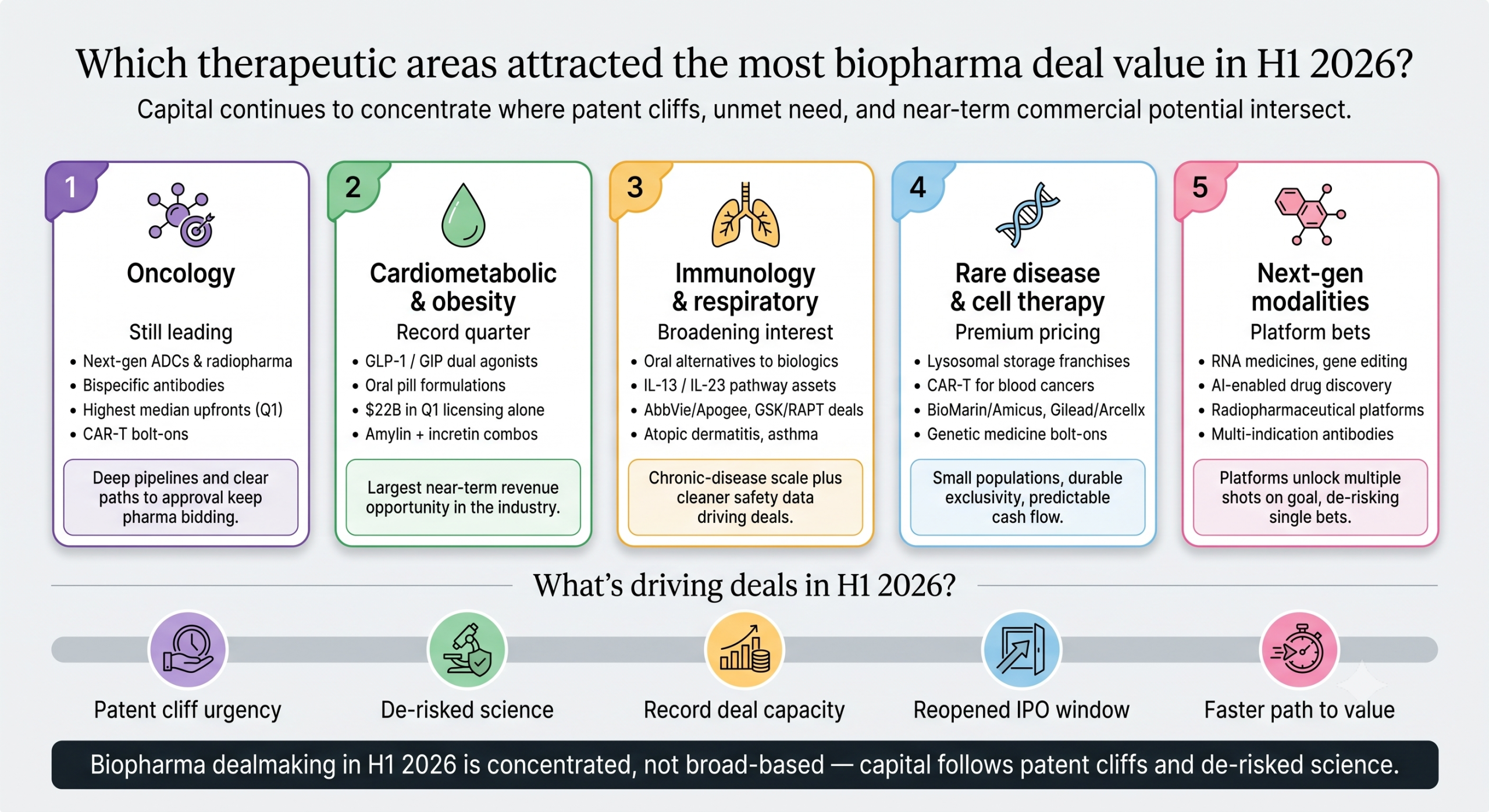
So why the urgency? One statistic explains most of it. GlobalData projects that only 4 percent of global drug sales will sit under patent protection by 2030, down from 12 percent in 2022. PwC pegs the branded revenue exposed to loss of exclusivity this decade at more than $300 billion. When that much revenue is walking toward the exit, buying a de-risked late-stage asset becomes the fastest way to stay in place.
The buyers have the means. Big pharma’s combined deal capacity across the top 25 companies sits near $1.3 trillion, one of the highest figures on record, and the 2025 spending spree barely dented it. IQVIA expects full-year 2026 M&A to land somewhere between $140 billion and $160 billion. A few of the headline transactions so far:
-
-
- Sun Pharma and Organon, an all-cash deal worth $11.75 billion and the largest of the year to date, expanding biosimilar and women’s health.
- AbbVie and Apogee, $10.9 billion for a late-stage immunology and respiratory pipeline.
- GSK and Nuvalent, $10.6 billion in oncology.
- Eli Lilly, which bought ten companies in the first half alone, including a $7.8 billion move for sleep-disorder biotech Centessa.
-
PwC’s read is that the era of the sprawling mega-merger has cooled. The action now lives in precise, mid-cap, bolt-on science. As their US deals leader put it, the new phase is driven less by scale and more by precision.
Where the Capital is Actually Flowing
If you want to know what large pharma is chasing, follow obesity.
Eli Lilly became the first pharmaceutical company to announce it crossed a $1 trillion market capitalization, carried there by demand for its metabolic franchise. The company guided to 2026 sales of $82 to $85 billion, roughly 25 percent growth. Novo Nordisk’s oral Wegovy hit 3 million cumulative prescriptions by June 7th, and Lilly’s own pill, Foundayo, reached the US market in April. Lilly’s CEO told CNBC that 20 to 25 million patients are already on these medicines and described the addressable market as, simply, gigantic. Goldman Sachs thinks the pill segment alone could be worth around $22 billion by 2030, inside a weight-loss category approaching $100 billion.
Obesity is the headline, but it is not the whole story. Capital is concentrating in a handful of areas where the science has matured: antibody-drug conjugates and oncology, cardiometabolic, immunology and inflammation, plus next-generation modalities like RNA medicines and radiopharmaceuticals. A growing share of early innovation is coming out of China, often through licensing rather than outright acquisition, which is quietly reshaping where pipelines originate.
The IPO Window Cracked Back Open
For two years the exits were closed. That changed fast. Six biopharma IPOs in the first quarter raised $1.8 billion, already more than all of 2025. Then the record for the largest biotech IPO ever got broken twice in two months, first by Kailera Therapeutics at $625 million and then by Parabilis Medicines at $670 million. The XBI biotech index climbed 64 percent over the trailing year, according to Jefferies.
Venture money tells a more selective story. J.P. Morgan put first-quarter biopharma venture funding at $5.2 billion, with capital tilting heavily toward later, more de-risked rounds. Licensing was where the real volume showed up, reaching $77.3 billion in announced value, though upfront cash made up only about 6 percent of that total. Translation: investors are still writing big checks, but they are structuring them around milestones and asking companies to earn the back end.
The Policy squeeze is no Longer Theoretical
The first ten Medicare-negotiated drug prices took effect on January 1, 2026. The second round, fifteen drugs that include Ozempic and Wegovy, lands in 2027, and CMS estimates it would have cut net spending on those products by 44 percent had it been in force in 2024. On top of that, the administration’s most-favored-nation deals helped create the framework for Lilly and Novo to offer a $245 Medicare price on their GLP-1s. A third negotiation round, reaching into Part B for the first time, is already underway for 2028.
For commercial teams, this is the new normal. Blockbuster economics now come with a built-in countdown, and the financial models have to assume the price conversation starts earlier than it used to.
The Talent Equation: The Part Most Decks Skip
Here is the trend that does not make the front page but probably should.
In the first four and a half months of 2026, biopharma companies cut or announced cuts to about 14,167 jobs, a 24 percent jump over the same stretch in 2025. The surprising part is that those cuts came from fewer companies, 52 versus 114 a year earlier. So the reductions are getting larger and more concentrated, even as the broader industry stabilizes. EY expects total layoffs for the year to stay under 5 percent.
But “layoffs are up” is the wrong takeaway, because the same companies are hiring. Takeda is cutting roughly 4,500 roles through its transformation program while carrying 2,200 open positions globally, prioritizing launch and pipeline talent. When Gilead closed its $7.8 billion Arcellx acquisition, it reduced the acquired workforce by close to 87 percent, then staffed up where the assets actually needed support. BioMarin trimmed dozens of overlapping roles after its $4.8 billion Amicus deal for the same reason.
Read those three examples together and a pattern emerges. The headcount is not shrinking so much as getting rebuilt, fast, in response to events. A deal closes. A trial reads out. An FDA meeting demands a regulatory answer in weeks. Each of those moments creates a sudden, specific, and often temporary spike in demand for senior expertise that a fixed org chart was never designed to absorb.
A Question Worth Sitting With
So here is the thought we would leave with senior leadership heading into the back half of the year.
In an industry this event-driven, where a single acquisition can double your clinical workload overnight and a pipeline reprioritization can hollow out a function you spent two years building, how much of your team should be fixed, and how much should flex?
Most organizations still answer that question by default rather than by design. They hire permanently for work that is inherently temporary, then face the painful correction when the milestone passes. The companies navigating 2026 well seem to be the ones treating expertise as something they can dial up and down deliberately: a stable core for the work that never stops, and trusted expertise they can bring in for the integration, the submission, the trial, or the launch that defines the next two quarters.
That is the model BioPoint was built around, augmenting your team with SME consultants exactly when a milestone demands depth you do not need to carry year-round. We mention it not as a pitch but as a prompt, because the leaders who get the core-and-flex balance right tend to be the ones still hitting their dates when everyone else is either overstaffed or scrambling.
The rest of 2026 will reward agility, smart capital, and the discipline to put the right expertise in the right seat at the right time. The deals will keep coming. The cliff is not moving. The question is whether your team is structured to meet the moment, or merely to survive it.
——————————————————–
Sources
- PwC, Pharmaceutical and Life Sciences: US Deals 2026 Midyear Outlook
- STAT and BioPharma Dive M&A trackers (via eMarketer)
- AbbVie and Apogee Therapeutics press releases and SEC filings, June 2026
- GlobalData, patent-protection share projections
- IQVIA, 2026 M&A forecast and obesity market outlook
- J.P. Morgan / DealForma, Q1 2026 Biopharma Venture and Licensing Reports
- CNBC, Eli Lilly and Novo Nordisk earnings coverage
- Goldman Sachs, oral GLP-1 market forecasts
- KFF and CMS, Medicare Drug Price Negotiation Program
- BioSpace and Fierce Biotech layoff trackers; PharmaVoice and EY workforce commentary
- Jefferies, XBI index data